In a society that lauds “overworking” and whereby constant and chronic periods of stress are viewed as “the norm”, I ask, couldn’t we all benefit to take some more time for ourselves to determine what makes each one of us individually happy? Is something like this possible? Where does this “time for ourselves” originate? How does one find this time? Speaking in terms anecdotal evidence, is there an (inversely) correlational relationship between “stress” and “happiness”? Enter Gretchen Rubin, a best-selling author, podcaster, and speaker on topics relating to happiness and good habits.
In Rubin’s 2009 work The Happiness Project, she aspires to integrate new habits into her life and records her individual progress over a one-year period. Her goal? She aims to be accountable for her newfound “good habits” and determine if these habits have served to increase her self-reported level of overall happiness with her life.
Her work begs the question whether something as subjective as ‘personal happiness’ can be quantifiable in some sort of way and tracked over time. Of particular interest to me, in one month, Rubin sets out to keep a private and personal ‘gratitude journal’ or a notebook of organized (3) three bullet pointed entries relating to gratitude, or what she is currently thankful for in her life.
The aim of the journal is for one to set aside a certain time of day in which to think introspectively and reflectively to in order develop three unique personal and daily perceptions, which are to be recorded and maintained as a habit over time.
A sample of a personal entry;
- I am grateful for the walk in the park that I was able to do today. I am glad that I live near some nice nature/greenery.
- I am thankful for my supportive significant other.
- I am glad that I view my home as a calming focal point in my life whereby I can adequately relax and unwind from a stressful day.
As per the research referenced in Rubin’s work, those who practice gratitude are more thankful/gracious and report feeling “happy” more often than those who do not practice gratitude.
In theory, the self-reported feelings of “happiness” could develop through this task by not only (1) taking time to think critically about and record these “happy reflections” but also (2) “happiness” could be generated as a collective and commemorative personal work is organically produced with time, which can also serve as a reference piece in times of future need.
For Rubin, embarking on this sort of task served to not only celebrate both the large and subtle calming and reassuring nuances of her chaotic life, but she was able to do so in an otherwise unassuming (via private journaling) and simple (non time consuming) manner.
As a side note, those who have read her work, may agree that I am giving Rubin too much credit, as evidenced by her otherwise rudimentary (and mildly superficial) explanations found within her work. By the end of her book, The Happiness Project, one would expect that she would have come to some sort of interesting and/or thought-provoking revelations as her “year of change” concluded. Instead and unfortunately, Rubin is presented as more self-interested than when she began the book. Because of this, I don’t recommend for others to necessarily seek out this work. However, although I was not inspired by her writing per se, I was inspired by Rubin’s framework and her ideas for her writing. (For more information, see Rubin’s blog post entry (2006) on keeping a gratitude journal.)
In 2015, with Rubin’s idea serving as a reference point, I aimed to start a ‘gratitude journal’ of my own. What started as sporadic short and simple entries in bullet point format, with time became a daily writing habit of formed passages –a habit that would have otherwise not made writing a blog entry like this possible.
Beyond reducing stress and beyond inciting personal joy and happiness, over time, my gratitude journal served much more to me than just a more or less rigid structure of a dedicated time, place, and experience to print benedictions on bounded pages. Through journaling as a task, I was able to track larger ideas and concepts that I deemed important in my life as well. I was able to recognize patterns in my thoughts and even plan future goals accordingly. As a result, my voice and my focus in terms of what I wanted in my life became developed and organized over time.
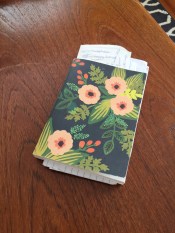
This journal, which once contained a few pen marks, has become an essential component of my day. I carry this journal with me, with a black pen readily accessible between the pages, and am never without it. It is almost an extension of the palm of my hands. I do so to not only make entries when a unique thought has entered my consciousness but also as reference to words of my days past. The pages contain hopes, dreams, and desires of a bright future ahead and even the proverbial ‘trail of bread crumbs’, if you will, say if I feel lost or side-tracked within the mild chaotic-ness of everyday living. Most importantly, the blank pages remaining in the journal provide a safe space for me to brain storm words, suggestions, and phrases necessary to work through current life issues and stresses. It feels uniquely wholesome and almost spiritual to carry around a book that contains words solely written by my own hand and in my own unique voice. The completed pages carry so much meaning for me. The pages that are yet to be completed represent additional ideas that are soon to be had. I now cannot imagine living without it.
COMING SOON: 8 Topics I Pursue in My Gratitude Journal
[Landscape Photo Credit — Jake Epstein — Frenchtown, NJ]
 Due North Vegan
One thought on “A Gratitude Journal: To Set Aside Time to Think About Time”